






Most work platforms promise speed and clarity, then bury users under tabs, plug-ins, and half-finished features. novapg doesn’t pretend to be light or cute. It aims to replace the mess entirely. That ambition matters more than any single feature, because it reveals who the platform is really for: people who are tired of stitching tools together and want one place that actually holds.
The interest around novapg isn’t coming from hype cycles or loud marketing. It’s coming from operators, creators, and small teams who already know what’s broken in their daily workflow and don’t need a lecture about productivity theory. They want fewer handoffs, fewer logins, and fewer things to babysit.
Why novapg appeals to people who already tried everything else
The typical path looks like this: a team starts with one tool, adds another for chat, another for files, another for payments, another for reports. Soon the work isn’t the work anymore. It’s managing the stack.
novapg attracts users who have already been through that phase. They aren’t beginners. They know what task boards do. They know what shared drives do. What they’re missing is continuity.
In novapg, tasks, conversations, documents, data, and transactions live in the same environment. That changes behavior. People stop copying information from one app to another. Decisions stay closer to the work that triggered them. Context doesn’t leak.
This is why novapg often replaces three to five tools at once instead of competing with just one. It’s not trying to be better than a single feature competitor. It’s trying to make the comparison irrelevant.
The central dashboard is not about visibility, it’s about pressure
Dashboards are usually sold as visibility tools. That’s not the real value here.
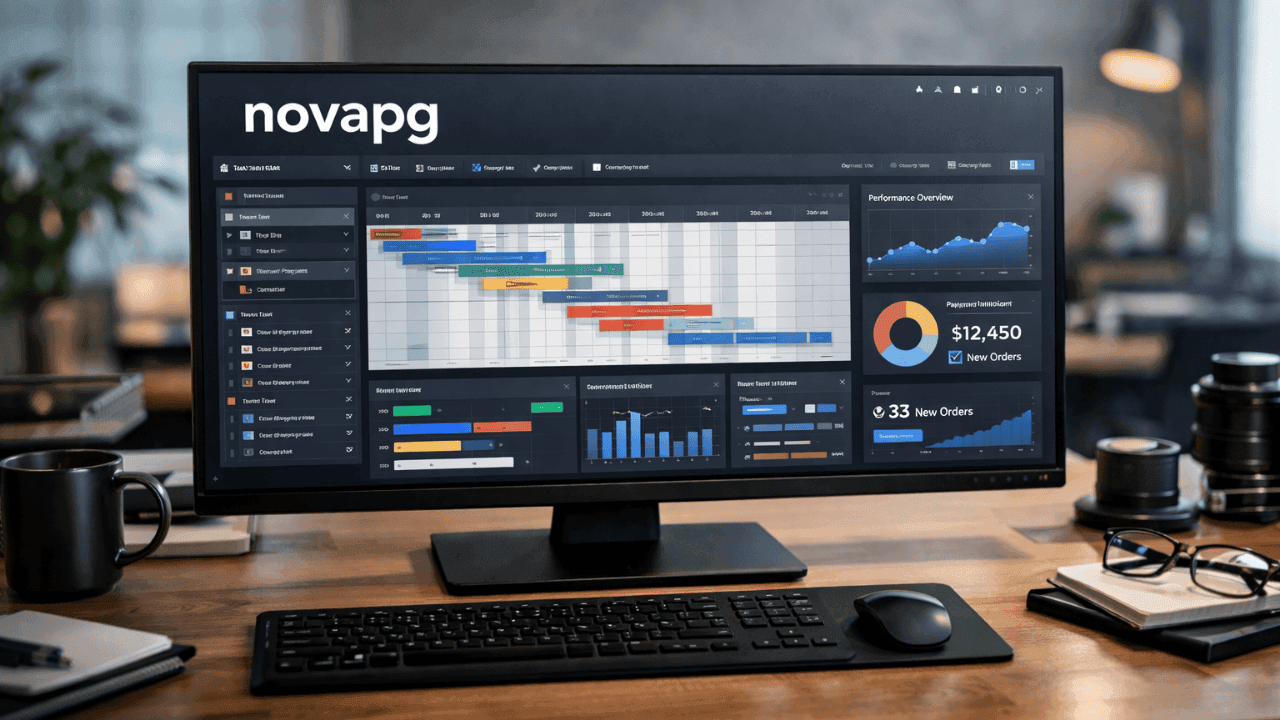
The novapg dashboard puts unfinished work, deadlines, performance signals, and financial movement in one view. That creates pressure. Not artificial pressure, but the kind that comes from seeing the whole picture at once.
When revenue, delivery status, and workload live side by side, weak spots show themselves fast. Missed handoffs can’t hide in a different app. Overloaded team members become obvious. Idle projects feel uncomfortable.
This is one of the reasons novapg resonates with founders and leads. It doesn’t flatter. It exposes.
Automation in novapg replaces habits, not people
Automation is often pitched as labor reduction. That framing misses the point.
In novapg, automation mostly replaces bad habits. Manual follow-ups. Forgotten approvals. Status updates that exist only to reassure someone who lacks access.
Workflows can be set to move tasks forward based on conditions instead of reminders. Notifications fire when something actually changes, not on a fixed schedule. Payments trigger access. Access triggers delivery steps.
This doesn’t eliminate human judgment. It removes the need to remember trivial steps. Teams that use novapg well don’t talk about saving time. They talk about fewer interruptions.
Collaboration without the side noise
Real-time chat and shared files are table stakes now. The difference is where they live.
In novapg, conversations attach to work objects instead of floating freely. A message belongs to a task. A file belongs to a project. Comments live next to decisions.
That structure reduces the background noise that kills focus in most teams. People don’t scroll endlessly to find context. They open the work and the context is already there.
For remote and hybrid teams, this matters more than any meeting policy. novapg quietly pushes communication toward relevance instead of volume.
Data storage that actually respects permission boundaries
Most platforms talk about security in abstract terms. novapg approaches it operationally.
Access rules are tied to roles, projects, and workflows. That means people see what they need when they need it, and nothing else. As work moves, access can move with it automatically.
For small businesses and creators handling payments or sensitive client data, this design choice reduces risk without adding friction. You don’t need a security specialist to avoid obvious mistakes. The system nudges you toward safer defaults.
Monetization inside the same workspace changes how creators work
One of the clearest signals that novapg isn’t just another internal tool is its payment and monetization layer.
Creators and service providers can manage subscriptions, invoices, and access from the same place they manage delivery. That collapses the gap between selling and doing.
When payment status is visible inside the workflow, priorities shift. Late payments don’t get ignored. Free work doesn’t sneak in unnoticed. Access can be granted or revoked based on real conditions, not awkward messages.
This is why novapg has found traction among independent creators and small agencies. It treats money as part of the process, not an external chore.
Analytics that reward attention, not vanity
Reporting tools often drown users in charts that look impressive and say little.
novapg focuses analytics on operational signals: throughput, bottlenecks, completion rates, revenue flow tied to delivery. These aren’t numbers for slide decks. They’re numbers that tell you where to intervene tomorrow morning.
Because the data lives inside the same system where work happens, the feedback loop is short. A trend shows up. A change gets tested. The impact becomes visible without exporting anything.
This is one of the quiet strengths of novapg. It doesn’t ask users to become analysts. It gives them just enough signal to act.
How novapg stacks up against task-only tools
Comparisons to task managers miss the point, but they still come up.
Tools like Trello or Asana are good at organizing tasks. They stop there. Everything else happens somewhere else.
novapg treats tasks as one layer of a larger system. A task can trigger automation, affect access, influence payment status, and feed analytics. That interconnectedness is the difference.
For teams whose work stops at task completion, novapg may feel heavy. For teams whose work includes delivery, billing, and ongoing relationships, it fits naturally.
The learning curve is real and intentional
There’s no honest way around this: novapg takes time to learn.
That’s not because it’s poorly designed. It’s because it’s broad. People used to narrow tools need to adjust how they think about setup. The payoff comes after structure is in place.
Teams that rush onboarding often get frustrated. Teams that invest upfront tend to stay. This filters the audience in a way that actually benefits the platform. novapg isn’t chasing casual usage.
Who gets the most value out of novapg
novapg shines in environments where work has consequences beyond completion.
Small businesses juggling clients, delivery, and cash flow. Creators selling access, services, or subscriptions. Remote teams who need accountability without constant meetings.
Solo users looking for a simple to-do list will likely feel constrained. That’s fine. The platform isn’t trying to win everyone.
Why novapg feels different after a few months
The real effect of novapg shows up over time.
As workflows stabilize, people stop asking where things live. They stop forwarding messages. They stop double-checking whether something was paid or approved.
The system becomes boring in the best way. Work moves. Problems surface early. Decisions stick.
That’s not a flashy outcome, but it’s the one serious operators care about.
The risk of using novapg without intent
One warning deserves attention.
novapg amplifies structure. If your processes are unclear, it will expose that. If your rules are inconsistent, it will enforce them inconsistently.
Teams that treat novapg as a magic fix often blame the tool. Teams that treat it as an amplifier get results.
This isn’t a platform for avoidance. It rewards clarity and punishes indecision.
Where novapg fits in a crowded software landscape
The software market is full of single-purpose tools fighting for attention. novapg sits outside that noise.
It competes less on features and more on consolidation. It asks a simple question: why manage work, communication, data, and money in separate places when they depend on each other?
For a growing segment of users, that question lands.
A clear takeaway for anyone considering novapg
novapg is not about doing more. It’s about doing fewer things in fewer places with fewer excuses.
If you already feel the friction of tool overload, novapg won’t feel radical. It will feel overdue. If you expect instant simplicity without structural decisions, it will frustrate you.
The platform doesn’t sell comfort. It sells coherence. That’s why it sticks with the people it’s built for.
FAQs
- How long does it usually take to feel comfortable using novapg?
Most teams report a few weeks of setup and adjustment before things click. The shift is more mental than technical. - Can novapg replace accounting software entirely?
It handles payments and revenue tracking well, but most businesses still pair it with dedicated accounting for tax and compliance work. - Is novapg suitable for solo creators, or only teams?
Solo creators benefit most when they manage paid access, recurring clients, or complex delivery. Simple content workflows may not justify it. - What’s the biggest mistake new users make with novapg?
Trying to mirror old habits instead of redesigning workflows to take advantage of automation and shared context. - Does novapg lock users into rigid processes?
Only if they design rigid processes. The flexibility is there, but structure has to be chosen deliberately.