








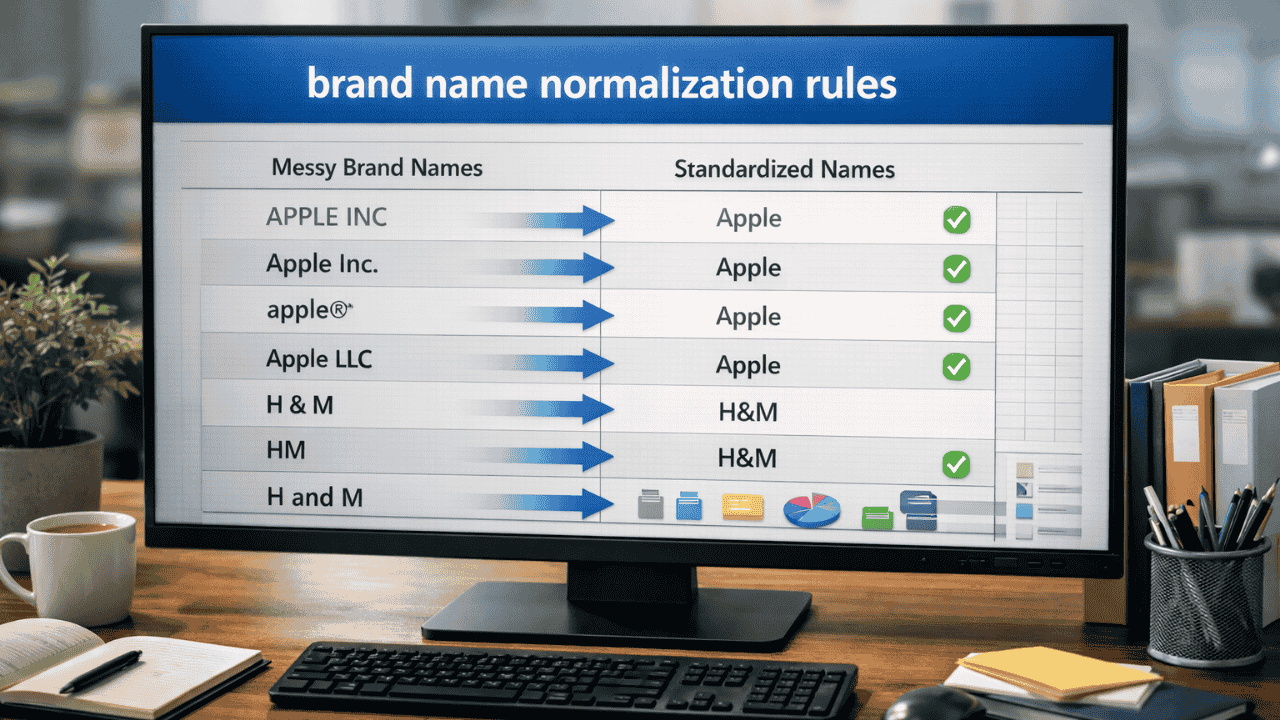
If your brand shows up as five different spellings across your database, you don’t have a branding problem—you have a discipline problem. I’ve seen teams waste weeks reconciling reports, cleaning CRM exports, and arguing over why dashboards don’t match, all because nobody enforced brand name normalization rules early. One loose naming habit multiplies fast. By the time you notice, your analytics are unreliable, your search results look sloppy, and your internal tools don’t agree with each other. Fixing it later costs far more than setting standards from day one.
The quiet damage inconsistent names cause inside real systems
Most teams think naming inconsistencies are cosmetic. They’re not. They break logic.
Picture a retail catalog. The same company appears as “Apple,” “Apple Inc,” “APPLE,” and “Apple®.” Your inventory system treats each as a separate vendor. Your finance report splits revenue. Your search tool returns partial results. Your marketing team can’t pull a clean performance report because the data fragments at the source.
This is where brand name normalization rules stop being a style choice and start acting like infrastructure. Clean names reduce duplicates, reduce manual fixes, and give every system a single version of the truth.
In one mid-size e-commerce catalog I worked on, cleaning brand fields alone cut duplicate listings by 18 percent. Nothing fancy—just consistent casing and removal of legal suffixes. That’s the kind of gain people chase with expensive software, yet it often comes down to naming hygiene.
Why search performance depends on disciplined naming
Search engines and internal site search both rely on consistency. If your site refers to “H&M,” “H and M,” and “HM,” the algorithm doesn’t magically connect them. It treats them as separate strings.
That means:
- weaker brand relevance signals
- split authority across multiple variations
- lower match rates for product searches
When brand name normalization rules are applied across titles, product feeds, and metadata, search performance stabilizes. One clear spelling accumulates all the signals instead of scattering them.
This isn’t theory. Product catalogs with normalized brand fields consistently show tighter search results and fewer “no results found” cases for branded queries. Cleaner input equals better output. Always.
Canonical names are the foundation, not a nice-to-have
Every brand in your system needs one official version. No debate. No alternates.
If the canonical form is “Nike,” then that’s it. Not “NIKE,” not “Nike Inc.,” not “Nike USA.” Everything else becomes a mapped variation that resolves back to the single approved version.
Teams that skip this step end up negotiating names every time new data enters the system. That’s chaos disguised as flexibility.
Strong brand name normalization rules start with a master list that lives somewhere visible: database table, style guide, or shared documentation. Everyone—from content writers to engineers—pulls from that source. No freelancing.
Once this list exists, automation becomes possible. Without it, every fix is manual.
Capitalization isn’t petty—it’s structural
People love to roll their eyes at casing standards. Until their reports break.
Case differences create separate entries in databases that treat text literally. “sony” and “Sony” don’t match unless you force them to. Multiply that across thousands of rows and you get reporting errors that nobody trusts.
Good brand name normalization rules lock casing:
- Title Case for standard brands
- All caps only for true acronyms like IBM
- no mixed weirdness like “iBM” or “SoNy”
Once enforced, merges become predictable. Your systems stop guessing.
This single rule prevents more downstream cleanup than almost anything else.
Legal suffixes usually create clutter, not clarity
“Inc.” “LLC.” “Ltd.” These words rarely help users and often hurt systems.
They inflate character counts, introduce variation, and create duplicates when one record includes the suffix and another drops it.
For most customer-facing or operational uses, stripping legal endings makes sense. Keep them for contracts or legal docs, not for product pages or search indexes.
Brand name normalization rules that remove these suffixes produce cleaner sorting, better grouping, and fewer mismatches.
You want “Apple,” not “Apple Inc.” fighting with “Apple Incorporated” in the same table.
Special characters are a silent source of errors
Ampersands, apostrophes, accents, and hyphens cause more trouble than teams expect.
“H&M,” “H & M,” and “H and M” look close to humans but not to machines. Same story with “Coca-Cola” versus “Coca Cola.”
Pick one treatment and apply it everywhere.
Either:
- keep the symbol consistently
or - replace it consistently
Half-and-half guarantees broken matching.
Brand name normalization rules should document exactly how each character type is handled. Otherwise new content keeps reintroducing the mess you just cleaned.
Abbreviations and full names can’t coexist peacefully
Choose between “IBM” and “International Business Machines.” Don’t allow both as primary labels.
Abbreviations feel convenient, but mixing them with full names splits data. Sales might log one version while marketing uses another.
I’ve seen CRM exports where half the leads sit under the acronym and half under the long name. Good luck building an accurate report from that.
Smart brand name normalization rules treat one as canonical and store the other only as an alias for matching.
That way the system recognizes both but displays only one.
How normalization saves time across departments
The real win isn’t aesthetics. It’s labor.
Clean brand fields mean:
- fewer manual merges in CRM
- cleaner spreadsheets for analysts
- simpler filters for merchandising
- less back-and-forth between teams
When brand name normalization rules are enforced upstream, nobody spends Fridays reconciling spreadsheets. Work flows without constant cleanup.
Teams often underestimate this. They assume normalization is a one-time chore. In practice, it’s a recurring time saver that pays back every week.
If you’ve ever heard “these numbers don’t match,” chances are naming inconsistencies are part of the problem.
Automation only works after standards exist
People jump straight to tools. Scripts. AI cleaners. Fancy matching engines.
Those tools fail without clear rules.
Automation needs instructions. Without defined brand name normalization rules, the system has nothing solid to enforce. It just guesses, and guesses create new errors.
The order should always be:
- define standards
- document them
- clean existing data
- automate enforcement
Reverse that order and you’re chasing noise.
Even a simple rule-based script—lowercase everything, strip suffixes, map aliases—handles most of the work once the standards are locked.
Handling international and regional variations without losing control
Global brands introduce tricky cases. A name might change slightly across markets or languages. That doesn’t mean you abandon structure.
Create one global canonical form, then map regional spellings as accepted aliases.
For example, local teams might use accented characters or translated names internally. That’s fine for context. But your core systems should still resolve everything to one consistent representation.
Brand name normalization rules become even more important at this scale because duplication multiplies across countries fast.
Without control, you end up with the same brand repeated dozens of times under slightly different spellings.
Common mistakes teams keep repeating
The worst approach is “we’ll fix it later.” Later never comes until the mess becomes painful.
Other recurring failures:
- letting each department maintain its own naming style
- allowing manual entry without validation
- skipping audits after imports
- assuming vendors will follow your standards
They won’t. If you don’t enforce brand name normalization rules at the point of entry, junk slips in every day.
Put guardrails in forms. Validate against your canonical list. Reject unknown variants automatically. Prevention beats cleanup every time.
A practical way to implement this without drama
Start small. Don’t attempt to cleanse ten years of data in one sweep.
Pick your top 100 brands by revenue. Standardize those first. Map common variations. Update your systems to enforce the rules going forward. Then expand gradually.
Momentum builds when people see immediate improvements in reporting and search.
Once teams experience how much smoother things run, they stop resisting the discipline.
That’s when brand name normalization rules stick—they stop feeling like bureaucracy and start feeling like common sense.
Conclusion
Sloppy naming looks harmless until it poisons your data. Then you pay for it every day in confusion, manual fixes, and unreliable reports. Brand name normalization rules are basic housekeeping, but they hold everything together. Treat them like infrastructure, not style advice. Lock the standards, enforce them, and stop letting tiny inconsistencies sabotage serious work.
FAQs
- How often should we audit brand names in our database?
Quarterly is realistic for most teams. If you import data daily from partners, run automated checks weekly. - Should we ever keep legal suffixes like Inc. or Ltd.?
Yes, but only in legal or contractual contexts. For catalogs, search, and reporting, drop them to avoid duplicates. - What’s the fastest way to clean old messy data?
Export, normalize with a rule-based script, then re-import against a validated canonical list. Don’t try to fix records one by one. - How do we handle new brands entering the system?
Require them to be added to the canonical list first. Block free-text entries that bypass validation. - Can AI tools replace manual rule setting?
No. AI can help detect variants, but it still needs clear brand name normalization rules to know what “correct” looks like.