








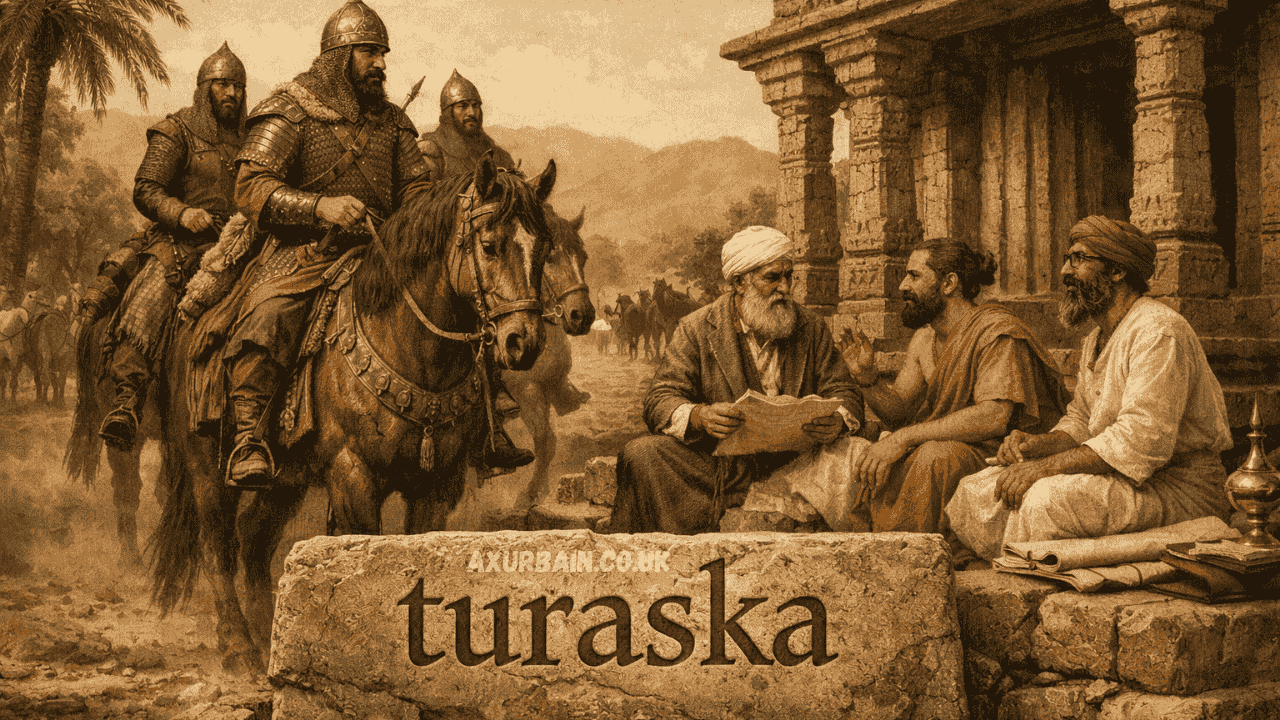
The word turaska carries a quiet weight from the past, yet most people today have never heard of it. It appears in old Sanskrit writings and reflects how ancient societies described people beyond their borders. Unlike modern labels, turaska was shaped by cultural encounters, trade, and conflict over centuries. Understanding turaska opens a window into how early Indian scholars viewed foreign communities. This article breaks down its meaning, usage, and why it still matters in modern discussions.
the origin and linguistic roots of turaska
The term turaska is rooted in classical Sanskrit, where it was used to describe people from Central Asia, particularly Turkic groups. Variations such as turushka and turuska appear in different manuscripts, but they all carry a similar meaning. These variations reflect differences in pronunciation and regional writing styles over time. The word itself evolved as Indian scholars interacted with foreign traders and invaders. Over time, turaska became a recognizable label tied to identity and geography.
Language played a major role in shaping how turaska was understood. Sanskrit authors often used descriptive names for communities based on origin or behavior. In this case, turaska was not just a random label but a reflection of real encounters. The consistency of its usage across texts shows that it had a well-established meaning. Even today, studying such terms helps trace the movement of people and cultures across regions.
turaska in ancient indian literature
Turaska appears in several well-known Sanskrit texts that documented social and political life. These references were not casual mentions but often carried context about foreign presence and influence. Writers used turaska to describe groups that came from beyond the traditional boundaries of the Indian subcontinent. These mentions give insight into how outsiders were perceived and categorized.
In literary works, turaska was sometimes linked with military activity or trade interactions. This shows that the relationship between local kingdoms and these foreign groups was complex. Some texts portrayed them as powerful outsiders, while others simply noted their presence. The repeated appearance of turaska in literature highlights its importance in historical narratives. It also shows that ancient writers were aware of global connections long before modern globalization.
connection between turaska and central asian tribes
The meaning of turaska is closely tied to Central Asian tribes, especially those identified as early Turkic groups. These tribes moved across regions for trade, settlement, and conquest. Their interactions with Indian kingdoms led to the adoption of the term turaska in local writings. This connection is key to understanding the broader historical context behind the word.
Central Asian tribes influenced many aspects of life, including trade routes, military strategies, and cultural exchanges. The presence of these groups was strong enough to leave a mark on language. Turaska became a shorthand way to refer to these outsiders without naming specific tribes. Over time, it represented a collective identity rather than a single group. This makes the word both specific in origin and broad in meaning.
how turaska reflected cultural and social perceptions
Turaska was more than just a label; it reflected how societies viewed outsiders. Ancient Indian texts often categorized people based on origin, customs, and behavior. The use of turaska shows a mix of curiosity and distance in how foreign groups were described. It highlights the human tendency to define identity through comparison.
Writers sometimes associated turaska with unfamiliar customs or different ways of life. This created a contrast between local traditions and those of foreign groups. However, the term was not always negative and could simply indicate geographic origin. This dual nature makes turaska an interesting case of cultural labeling. It shows how language can capture both difference and interaction at the same time.
modern usage and evolution of turaska
In modern times, turaska has taken on new meanings in certain languages. In Bengali, for example, turaska is used to refer to Turkey as a country. This shows how the word has evolved from a historical label to a geographic name. The shift in meaning reflects changes in political boundaries and cultural understanding.
Despite its evolution, the historical roots of turaska remain relevant. Scholars still study the term to understand early cross-cultural connections. Its survival in modern language proves that some words carry long-lasting influence. Turaska bridges the gap between ancient descriptions and modern identities. This continuity makes it valuable for both linguistic and historical research.
why turaska still matters today
Even though turaska is not widely used in everyday conversation, it holds importance in academic and cultural discussions. It helps historians trace how ancient societies interacted with foreign groups. The word also provides insight into how identity was constructed in earlier times. Studying turaska reveals patterns of migration and cultural exchange.
There are several reasons why turaska remains relevant today:
- it connects ancient indian texts with real historical movements
- it shows how language evolves over time
- it highlights early global interactions between regions
- it offers insight into cultural perceptions of outsiders
Each of these points shows that turaska is more than just a forgotten word. It is a piece of history that continues to inform modern understanding. By studying it, we gain a clearer picture of the past.
differences between turaska and similar terms
Turaska is often compared with other terms used in ancient texts to describe foreign groups. While many words existed, turaska had a specific association with Turkic or Central Asian people. This distinction is important when analyzing historical documents. It helps avoid confusion between different groups and regions.
Other terms might refer to general outsiders, but turaska points to a more defined identity. This makes it valuable for researchers studying specific historical interactions. The clarity of its meaning adds depth to textual analysis. It also shows that ancient writers were precise in their descriptions. Understanding these differences improves the accuracy of historical interpretation.
the role of trade and migration in spreading turaska
Trade routes played a major role in the spread of the term turaska. Merchants traveling between Central Asia and India brought not only goods but also cultural exchange. These interactions made foreign groups more visible to local populations. As a result, terms like turaska became more common in language and literature.
Migration also contributed to the wider recognition of turaska. Groups settling in new regions influenced local societies in multiple ways. This included language, customs, and even governance. The presence of these communities ensured that the term remained relevant over time. It became part of a shared historical narrative shaped by movement and exchange.
how turaska helps understand early global connections
Turaska offers a unique perspective on early global connections between regions. It shows that ancient societies were not isolated but actively engaged with others. The use of the term reflects awareness of distant cultures and people. This challenges the idea that globalization is purely a modern concept.
By examining turaska, we see evidence of early international relationships. These connections were built through trade, conflict, and cultural exchange. The word acts as a marker of these interactions in historical records. It reminds us that human societies have always been interconnected. This makes turaska an important term for understanding world history.
conclusion
Turaska is a small word with a deep and layered history. It began as a Sanskrit term describing Central Asian groups and evolved into a broader cultural and geographic reference. Its presence in ancient literature shows how early societies understood and interacted with outsiders. Over time, turaska adapted to new meanings while retaining its historical roots. Studying turaska not only reveals linguistic evolution but also highlights the long history of cultural exchange between regions. It remains a valuable term for anyone interested in history, language, and identity.
faqs
- what does turaska mean
Turaska refers to people from Central Asia, especially Turkic groups, as described in ancient Sanskrit texts. - where is the word turaska found
Turaska appears in classical Sanskrit literature and historical writings that discuss foreign groups and interactions. - is turaska still used today
Yes, in some languages like Bengali, turaska is used to refer to the country Turkey. - are turaska and turushka the same
They are variations of the same term, with slight differences in spelling due to language and regional changes. - why is turaska important
Turaska helps historians understand ancient cultural interactions, migration patterns, and how societies viewed outsiders.